
Writing in Public: Week 3
Project planning, building momentum, and trusting the process

Welcome to Week 3!

Welcome to Week 3 of the Writing in Public.
As expected, this week was more challenging. I struggled early in the week. The reasons were not new. It was the same struggle with distractions and self-doubt. As I focused on the process I was pleased to find out that by the end of the week, I had also made some progress. I kept reminding myself of the following quote by E.L. Doctorow.
Writing is like driving at night in the fog. You can only see as far as your headlights, but you can make the whole trip that way. E.L.Doctorow
I’ll start with the goals and status.
Progress
Goal: Write 2000 words
Status: Complete ✅
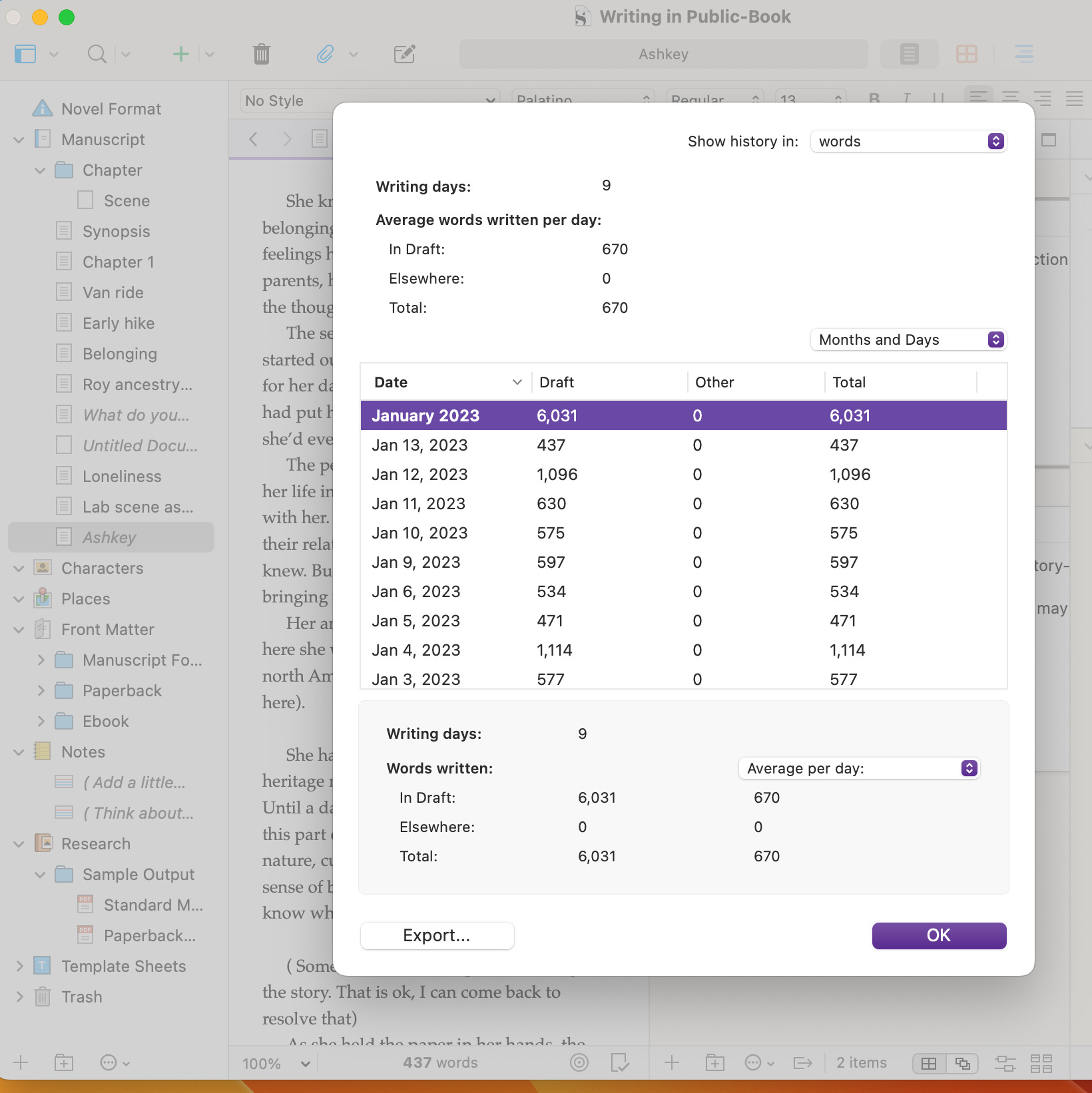
I was able to hit my word target, but like the previous week, the only way I was able to do this was by paying no attention to quality. I recently read somewhere that the primary goal of the first draft is to get the story out of our heads. Since this involves a lot of digging, it serves us best to focus on getting all the pieces out. Messiness is the natural part of the process. If we get all the pieces out, we can work on gluing them together and polishing them afterward.
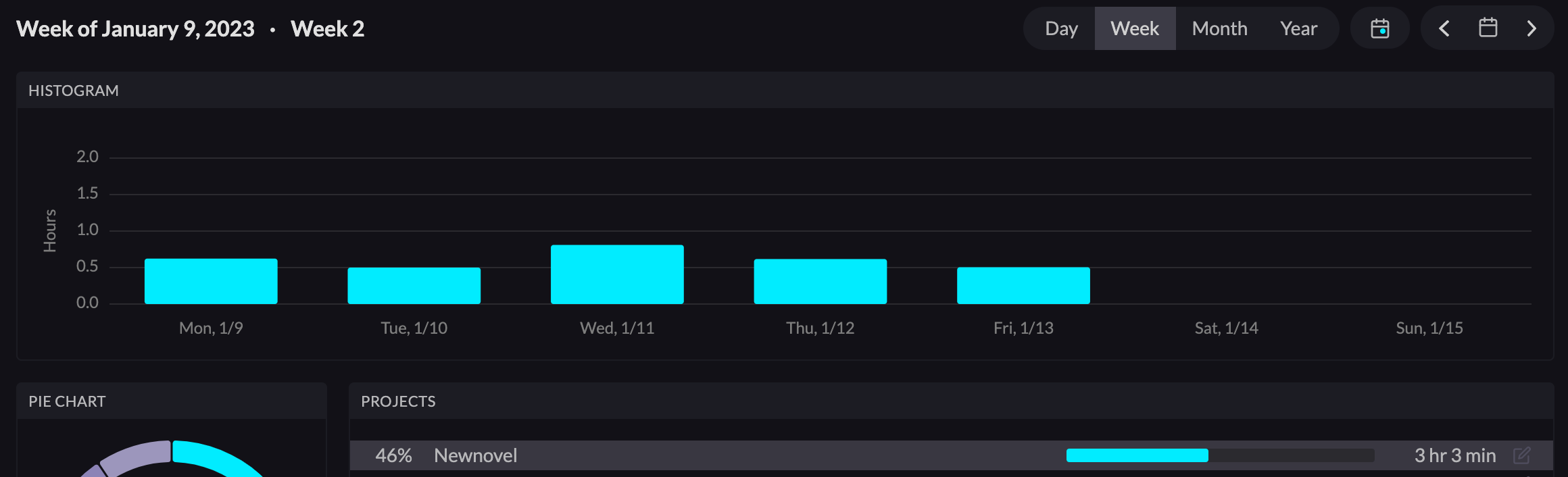
Here is what my time spent on this project looked like:
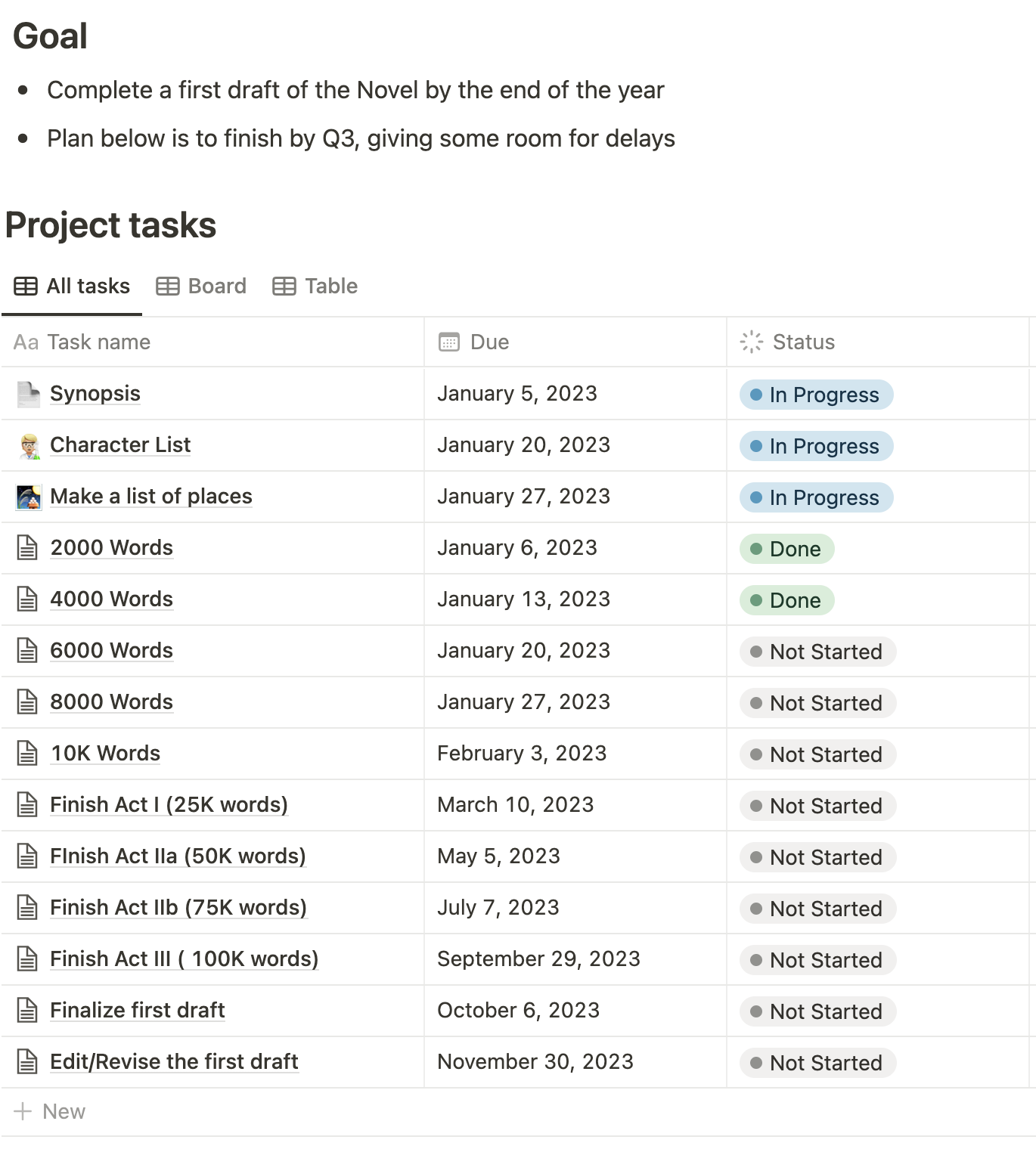
Goal: A rough timeline for the project
Status: Complete ✅
I have settled on a timeline. This was more challenging than I expected, as it deepened my commitment to the project. I expect to face the biggest drops in motivation around 30K words and 60K words. With that in mind, I have added two reminders to my calendar, one for the end of March and one for early June with the following title:
Trust the Process. You expected to lose motivation here.
Goal: Make a small list of books and resources to keep close by.
Status: Complete ✅
I have narrowed my resources to the following eleven books.
Writing Tips:
The Novel Project by Graeme Simison
Save the Cat by Blake Snyder
Consider This by Chuck Palanahuik
On Writing by Stephen King
Elements of Style by Strunk And White
Process and Motivation:
Deep Work by Cal Newport for motivation and how to continue a deep work practice.
Start Finishing by Charlie Gilkey for tools and systems. Also for how to get unstuck when I feel the urge to quit midway.
Big Magic by Elizabeth Gilbert for when my motivation dwindles.
Books to remind me of the beauty of stories:
A Gentleman in Moscow by Amor Towles
A man called Ove by Fredrik Backman
Interpreter of Maladies by Jhumpa Lahari
Ideas I was trying to incorporate.
This week I drew my lessons and inspirations primarily from two sources.
Hemingway said that if you don't want to stare at the blank page, stop midsentence.
I had heard this advice somewhere and decided to try it and see if it worked for me. It worked great as a fix for the blank page problem, but it created a different problem for me. I couldn't help but feel a bit frustrated at having stopped in the middle of a sentence. I found myself thinking about it all evening, and the temptation to go back and finish that sentence was very strong. I’ll keep this in my toolbox, but I likely will not be using it regularly.
Always think about the story from the point of view of a character- Joye Carol Oates.
I found this helpful for two reasons. Firstly, it helped me develop and better understand my characters. Secondly, by placing myself inside the head of the character, I could now create a vivid mental image of the scene in my mind. Thinking about the story from the point of view of the character also helped me see the scene through my character’s eyes. This gave me a more comprehensive understanding of the story and its characters. This will stay in the top drawer of my toolbox.
Key Takeaways
Our mind seeks the path of least resistance.
This week, as I sat down to write, I found myself thinking more about this newsletter than the story I am working on. After some reflection, I realized what was happening. When prompted to think deeply, my mind looked for a cognitively less demanding alternative. What was interesting is that my mind was doing this in an efficient manner, where it could still trick me into thinking I would be doing something productive. However, if the intention I had set for that time period were to work on the Novel, then anything else would be a distraction.
Intention matters
If I started a timer with a project tagged new Novel, I worked better rather than mindlessly working and trying to get motivated about writing.
Similarly, this may be the intention or a nudge for my brain, putting on a 40hz binaural beats playlist improved my focus.
Goals for this week
Write the next 2000 words.
Spend time trying to understand the main characters.
Subscribe below!
Subscribe below to get every episode right in your inbox. You can also check back here after Tuesday morning.